Tokenisation can create new opportunities, but it is not a business benefit in itself. At the first Ambit Tech Breakfast, we looked at when it makes sense and what to consider from a legal and practical perspective.
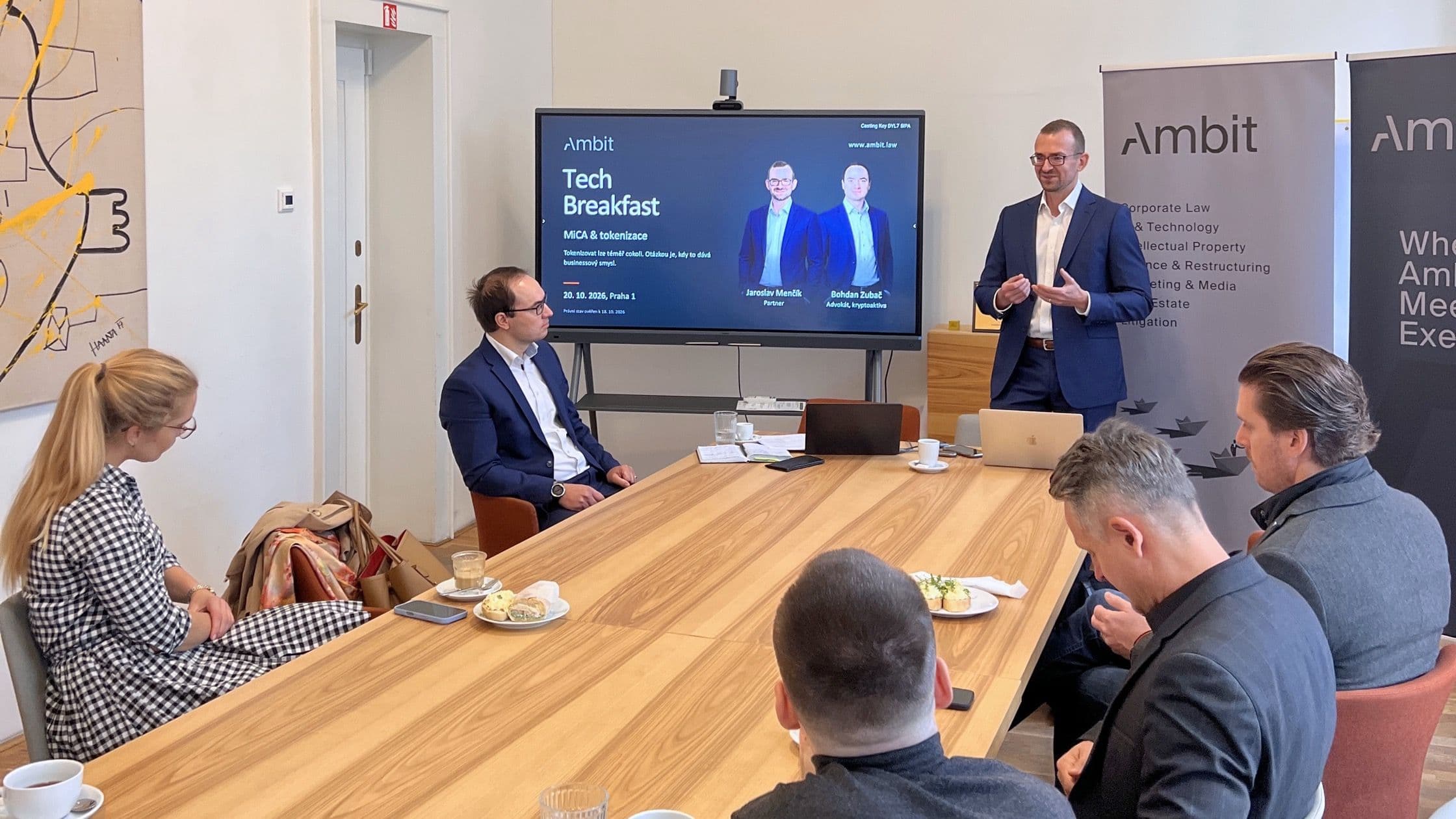
On Tuesday 20 October 2026, we held the first Ambit Tech Breakfast at Opero in Prague. The breakfast session brought together a small group by invitation. Jaroslav Menčík, partner at Ambit, opened the event and moderated the discussion, while Bohdan Zubač, an Ambit associate focused on crypto-asset regulation under MiCA and digital finance, led the expert session.
What we discussed
The expert session covered three areas:
- Why tokenise, and when it does not make sense. We considered where a token or blockchain creates business value and when it is unnecessary. Tokenisation is useful when it addresses a specific need, such as making transfers easier or allowing an investment to be divided.
- Where MiCA ends and other regulation begins. Utility tokens, stablecoins, NFTs and tokenised bonds can each fall under different rules. Alongside MiCA, the relevant framework may include capital markets, payments and AML. The legal nature of the token and the roles of the issuer and service provider matter.
- Tokenisation in practice. We discussed Lufthansa and Uptrip, Siemens digital bonds, Société Générale’s EUR CoinVertible stablecoin and an ESOP programme on CDCP infrastructure. The conversation also considered when it is more sensible not to tokenise at all.
The expert session was followed by an open floor for participants’ questions and discussion. The format allowed time to explore the detail and address specific questions raised by those in the room.
Five practical takeaways
Jaroslav Menčík drew five practical conclusions from the discussion:
- Tokenisation needs a business benefit. This might mean easier transfers or the ability to divide an investment. The technology itself is not a reason to tokenise.
- The same technology can be subject to different regulation. The legal nature of the token is what matters, rather than simply the blockchain on which it operates.
- A token does not necessarily mean ownership of an asset. What matters is the rights it actually gives its holder.
- A CASP authorisation requires more than documentation. The processes described must work in practice. Bohdan advises on MiCA and AML/CFT, CASP licensing and compliance for blockchain projects. He was part of the legal team behind one of the first CASP licences under MiCA in the Czech Republic.
- Regulatory costs can change a project’s economics. They need to be factored in from the outset.
What next
If you are considering tokenisation or need to assess the regulatory framework for a project, we can discuss its commercial and legal aspects. Find out more about our MiCA, CASP licensing and compliance services. You are welcome to contact Jaroslav Menčík or Bohdan Zubač to discuss your questions.