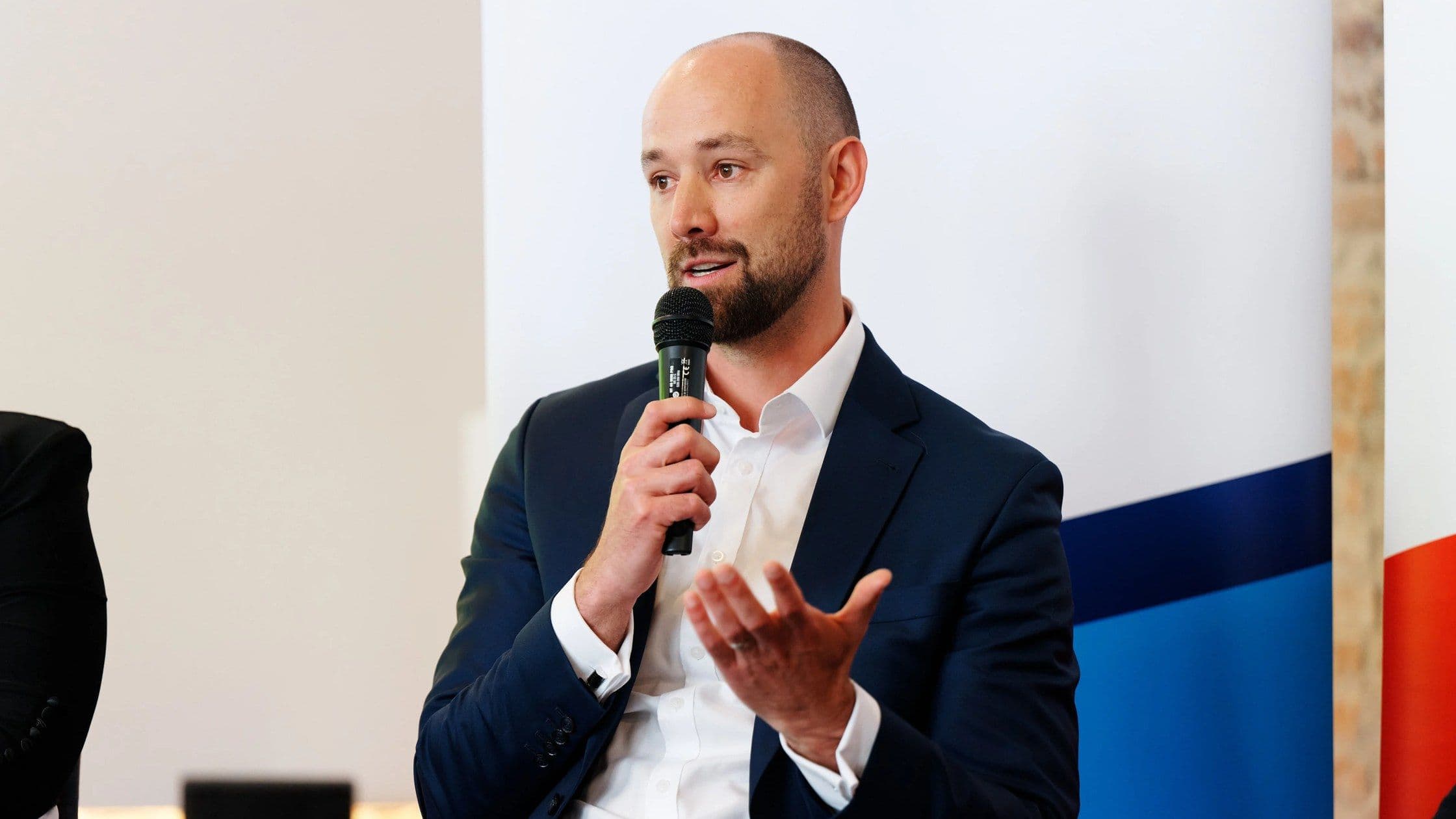
At the Law and Tax (Právo a daně) conference, Tomáš Ditrych, founder and managing partner of Ambit, discussed how to choose an appropriate employee incentive scheme. Phantom shares, traditional share schemes and qualified options each have their place. The new regime in force since January 2026 addresses the long-standing problem of tax arising before liquidity, while practical use still depends in part on determining market value.
At the Law and Tax (Právo a daně) conference, held on 13 May 2026 at Truhlárna in Prague and organised by Ekonomický deník and Česká justice, Tomáš Ditrych, founder and managing partner of Ambit, joined the panel ‘Tax and competitiveness: what concerns Czech business and taxpayers?’. As well as employee shares, the discussion covered tax returns, digitalisation, research and development tax relief, the start-up law and the future of corporate taxation. Alžběta Vejvodová chaired the panel. The opening address was given by Simona Hornochová, Director General of the Financial Administration. Finance Minister Alena Schillerová also spoke, presenting the planned EET 2.0 (the revived electronic sales records system) and the tax exemption for tips in hospitality. The conference programme provides further details.
Choosing an employee incentive scheme depends on the company’s aims and structure, as well as whom it wants to reward with a stake in its value. The Czech Republic offers three models. Each has its place: they differ in whether they provide actual ownership, who can participate and when tax becomes due.
Why incentive schemes matter
An incentive scheme can give key people a stake in the company’s future value. Its design determines whether that stake amounts to actual ownership, what tax liabilities arise and whether the scheme fits the needs of the company and the people it wants to involve.
“In a start-up, you need to offer an exceptionally talented employee something more than a monthly salary, where you often cannot compete with large corporations. So you need to attract talent by offering them the option to acquire future shares in your company. That makes them a co-owner and motivates them to work on building the company together.”
Tomáš noted that option schemes can support the growth of businesses beyond technology start-ups: “It has been proven that countries with favourable option regimes attract a greater number of start-ups.”
Three models for different needs
- Phantom shares. This is a purely contractual arrangement that tracks the economic value of shares without giving the participant actual ownership. Payment is made on an agreed trigger event, typically a sale of the company. The scheme can be put in place within days, without amending the articles, involving a notary or registering changes; the cap table remains untouched. Contractors and advisers can also be included. Tax treatment is that of a bonus, with income tax and contributions due on payment. It can suit companies seeking a straightforward contractual arrangement, wishing to preserve their ownership structure or include people who are not employees.
- Qualified option programmes. The regime under section 6a of the Income Tax Act has applied since 1 January 2026 and allows participants to acquire real equity without tax arising before liquidity. The income is treated as other income and is not subject to social security or health insurance contributions. The scheme is available only to employees and to companies whose group remains within the turnover limit of CZK 2.5 billion or the asset limit of CZK 2 billion. Options may be exercised after at least three years, or earlier in the event of a qualifying exit or IPO. Market value must be determined when options are granted and the tax office must be notified. This model may suit eligible companies seeking actual ownership without tax arising before liquidity.
- Real share programmes. Employees receive actual ownership and dividend rights, allowing close alignment with the company’s interests. This model suits companies whose structure can accommodate direct ownership. Tax arises when the interest is acquired. The tax deferral introduced in 2024 has proved of limited practical use for start-ups, as an employee leaving the company could be required to pay the deferred tax.
What would help
For qualified options, determining market value when an option is granted remains a practical question. Tomáš said: “The current legislation requires market value to be determined when the option is granted and exercised, which is a fairly demanding exercise for a start-up. You can commission an expert valuation, but preparing one tends to be time-consuming and costly. In practice, a simple methodology for determining market value in these cases would be welcome.”
Simona Hornochová responded that she did not consider valuing shares a major obstacle, since start-ups also need to document the value of their business for investors. She welcomed discussions among interested parties about possible changes to the tax treatment of employee shares.
Ambit designs and implements all three types of scheme. You will find an overview on our ESOP page. Read more about Tomáš Ditrych. Ambit was one of the conference partners. We thank the organisers for the invitation and for a considered discussion.